Transactional SMS vs Promotional SMS: What’s the Difference (and Why It Matters)
Not every SMS your business sends has the same purpose.
An order confirmation telling a customer their purchase was successful is very different from a message offering them 20% off their next order.
One is primarily operational.
The other is marketing.
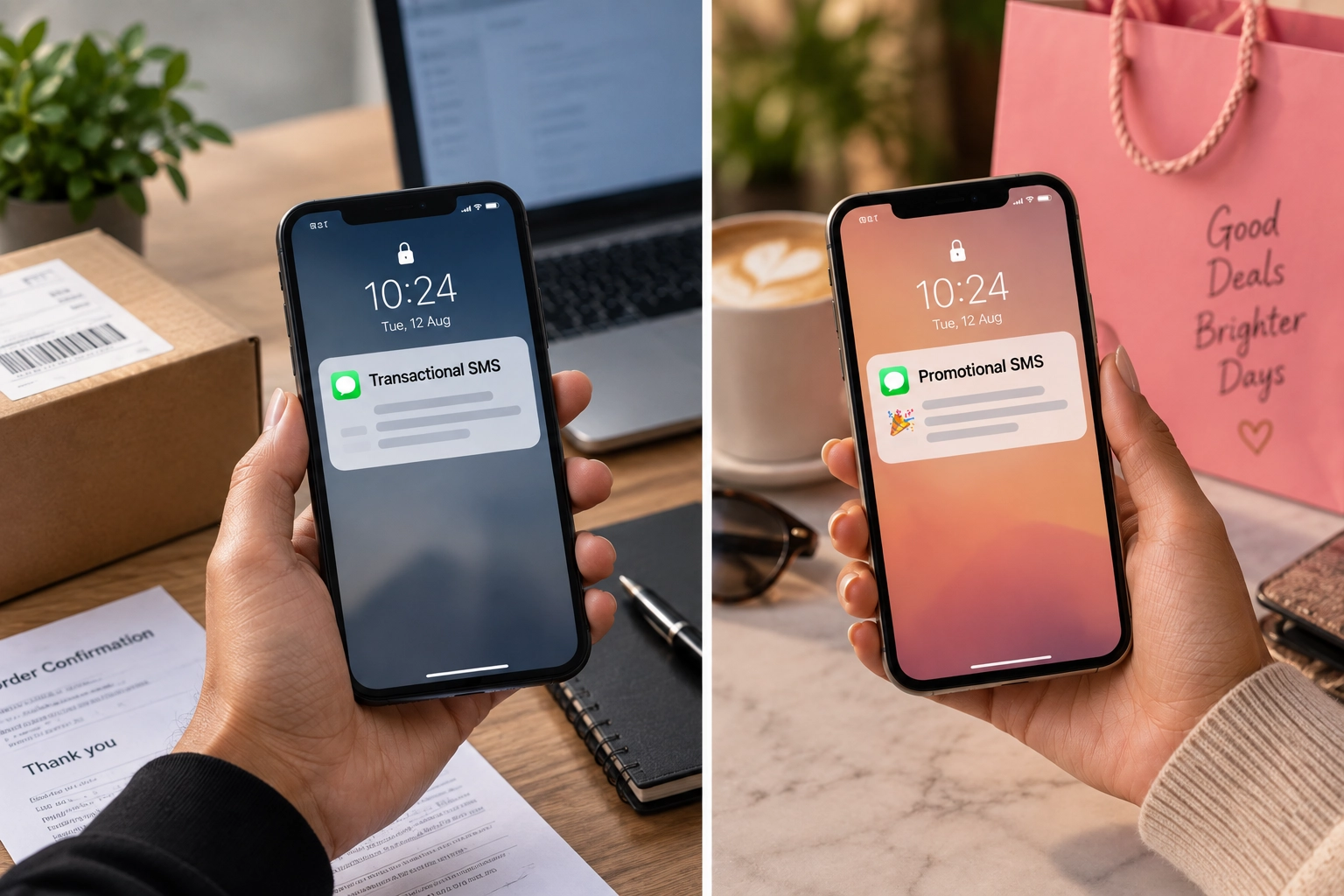
Understanding the difference between transactional SMS and promotional SMS matters because the purpose of the message can affect how you plan the communication, who should receive it, how quickly it needs to arrive and which marketing and compliance requirements need to be considered.
It also affects customer expectations.
Someone waiting for a one-time password or delivery update wants that message immediately. Someone receiving a promotional SMS is deciding whether the offer is relevant enough to deserve their attention.
For South African businesses using SMS for both customer communication and marketing, keeping these two purposes clear can help create better campaigns and a better customer experience.
So, what exactly is the difference between transactional SMS and promotional SMS?
What Is Transactional SMS?
Transactional SMS is generally used to provide information relating to an action, service, account or existing interaction.
Rather than trying to persuade someone to make a new purchase, the primary purpose is to provide information the recipient needs or expects.
Common transactional SMS examples include:
- Order confirmations
- One-time passwords (OTPs)
- Appointment reminders
- Delivery notifications
- Payment confirmations
- Account alerts
- Booking confirmations
- Service notifications
- Password reset codes
- Status updates
For example:
YOUR ORDER IS CONFIRMED: Thanks for your order #24815. We’ll SMS you again when it leaves our warehouse.
Or:
YOUR APPOINTMENT: Reminder that your appointment is tomorrow at 10:30. Reply YES to confirm or call [number] to reschedule.
These messages are triggered by a customer action, account activity or business process and are often expected by the recipient.
What Is Promotional SMS?
Promotional SMS is sent with a marketing or commercial objective.
Its purpose is generally to encourage the recipient to take an action such as making a purchase, booking a service, visiting a store or engaging with an offer.
Examples include:
- Sales and discounts
- Limited-time offers
- Product launches
- Seasonal campaigns
- New service announcements
- Loyalty promotions
- Event promotions
- Special offers
- Competitions
- Customer re-engagement campaigns
For example:
SPRING SALE 🌼 Save 20% on selected products until Sunday. Shop now: [link]. Reply STOP to opt out.
Or:
WE MISS YOU! Enjoy R100 off your next order when you spend R500 before Friday. Shop: [link]. Reply STOP to opt out.
The defining factor is not necessarily whether money is mentioned.
It is the marketing purpose of the communication.
A message announcing a new product may still be promotional even if it does not include a discount.
Transactional SMS vs Promotional SMS: The Main Differences
The easiest way to understand the difference is to compare the purpose of each message.
| Transactional SMS | Promotional SMS | |
|---|---|---|
| Primary purpose | Provide necessary or expected information | Promote a product, service, offer or business |
| Typical examples | OTPs, confirmations, reminders, alerts, delivery updates | Sales, discounts, launches, promotions, campaigns |
| Customer expectation | Usually expected following an action or relationship | Marketing communication |
| Timing | Often immediate or time-sensitive | Planned around campaign strategy |
| Main success measure | Successful and timely delivery | Engagement, clicks, leads, bookings or conversions |
| Marketing intent | No | Yes |
| Opt-out considerations | Depends on purpose and applicable requirements | Direct marketing requirements apply |
| Typical sending method | Often automated through a system or API | Bulk SMS campaign platform or marketing integration |
There can be grey areas, which is why businesses should focus on the actual purpose and content of the SMS rather than simply what they call it internally.
Transactional SMS Examples
Transactional messages appear in almost every industry.
Here are some common examples.
1. Order Confirmations
When a customer completes a purchase, an SMS can confirm that the order has been received.
Example
ORDER CONFIRMED: We’ve received order #24815. Track your order here: [link].
The purpose is to provide information about an existing transaction rather than encourage another purchase.
2. Delivery Updates
Customers want to know where their orders are and when they can expect delivery.
Example
DELIVERY UPDATE: Your order #24815 is out for delivery today. Track it here: [link].
This type of communication can also reduce the number of customers contacting the business simply to ask for an update.
3. Appointment Reminders
Medical practices, salons, service businesses and other appointment-based organisations can use SMS reminders to keep customers informed.
Example
REMINDER: Your appointment with [Business] is tomorrow at 14:00. Reply YES to confirm or call [number] to reschedule.
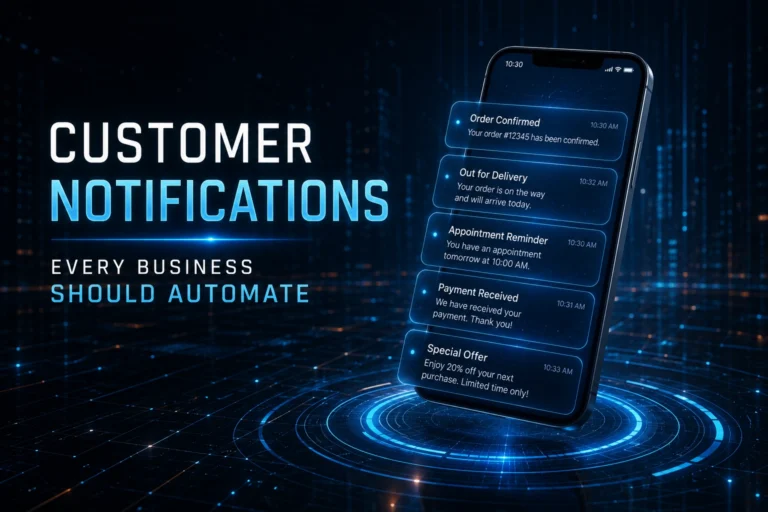
Appointment reminders are one of several useful customer notifications businesses can automate.
Businesses can use automation to send reminders, confirmations and other important customer updates without requiring staff to manually send every message.
4. One-Time Passwords and Verification Codes
OTPs are a clear example of transactional messaging because the recipient has usually triggered the communication themselves.
Example
Your [Business] verification code is 428917. This code expires in 10 minutes. Do not share it with anyone.
Speed is particularly important here.
A verification code that arrives after it has expired has little value to the customer.
5. Payment and Account Notifications
Businesses can also use transactional SMS to communicate important account activity.
Example
PAYMENT RECEIVED: Thank you. We have received your payment of R850.00. Ref: 14825.
Other examples could include balance notifications, payment-due reminders or account status updates.
6. Booking Confirmations
Hotels, restaurants, tourism businesses and other booking-based organisations can use SMS to confirm a reservation immediately.
Example
BOOKING CONFIRMED: Your table for 4 is booked for Friday at 19:00. Ref: ABC123. Call [number] if you need to make changes.
The customer has already made the booking. The SMS confirms what has happened.
Promotional SMS Examples
Promotional SMS serves a very different purpose.
The objective is usually to generate interest, engagement or action.
1. Sales and Discounts
This is one of the most familiar forms of promotional SMS.
Example
WEEKEND SALE: Save 25% on selected items until Sunday. Shop now: [link]. Reply STOP to opt out.
The offer is designed to encourage a purchase.
2. Product Launches
A message does not need to contain a discount to be promotional.
Example
JUST LANDED 👀 Our new summer collection is here. Be one of the first to shop: [link]. Reply STOP to opt out.
Its purpose is still to promote products.
3. Seasonal Promotions
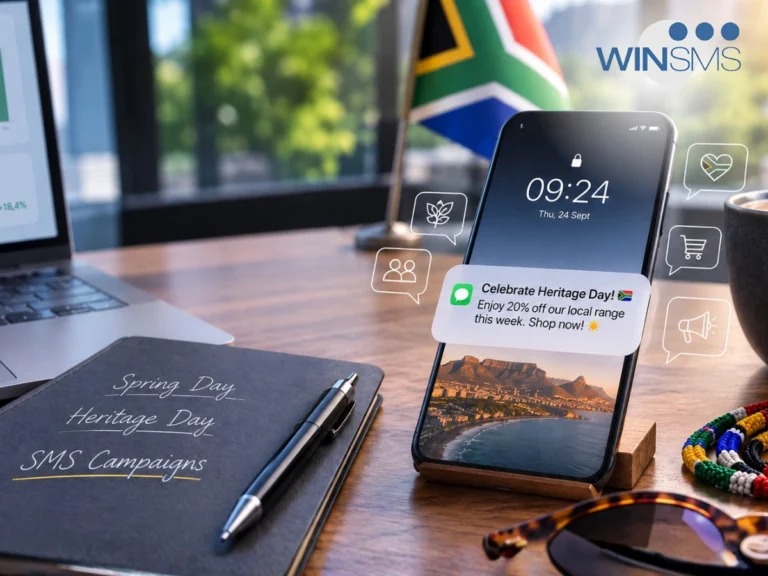
Spring Day, Heritage Day, Black Friday, the festive season and other calendar events can all provide reasons for promotional campaigns.
Example
HERITAGE WEEK SPECIAL 🇿🇦 Get 15% off selected local favourites until 24 Sept. Shop: [link]. Reply STOP to opt out.
Seasonal campaigns work best when the occasion is genuinely relevant to the business rather than simply providing an excuse to send another promotion.
4. Customer Re-Engagement
Promotional SMS can also be used to encourage an existing customer to return.
Example
WE HAVEN’T SEEN YOU IN A WHILE. Enjoy R100 off your next purchase over R500 before Friday: [link]. Reply STOP to opt out.
The fact that the person is an existing customer does not change the marketing purpose of the SMS.
5. Event and Campaign Promotions
Businesses can use promotional SMS to encourage registrations or attendance.
Example
YOU’RE INVITED: Join us for our Spring Open Day on 12 Sept. Reserve your place: [link]. Reply STOP to opt out.
If you are planning this type of communication, our guide to planning an SMS marketing campaign that converts covers audience selection, campaign objectives, timing, calls to action and measurement in more detail.
The Purpose of the SMS Matters More Than the Label
Businesses sometimes use internal labels such as:
- Service message
- Customer notification
- Account message
- Marketing message
- Automated SMS
- Bulk SMS
But the name given to the message internally does not necessarily determine its actual purpose.
Consider these two examples.
Message A:
Your order #24815 has been dispatched. Track delivery here: [link].
This is clearly an operational update about an existing order.
Now compare it with:
Message B:
Your order #24815 has been dispatched. Track it here: [link]. PLUS get 20% off your next order today: [promo link].
The first half is transactional.
The second half introduces a marketing offer.
Simply sending the message from a system normally used for transactional notifications does not remove that promotional intent.
This is one reason businesses should avoid casually adding marketing offers to service messages.
Why Mixing Transactional and Promotional SMS Can Be a Problem
It can be tempting to use the attention generated by an important customer notification to promote something else.
For example:
Your OTP is 428917. It expires in 10 minutes. Get 20% off when you shop today!
From a marketing perspective, it might look like an opportunity.
From the customer’s perspective, however, they asked for a security code — not a sales pitch.
Combining the two can create several problems.
It Changes the Purpose of the Message
Once promotional content is introduced, the SMS can no longer be viewed purely as an operational notification.
The business now needs to consider whether direct marketing requirements apply to that communication.
It Can Damage Customer Trust
People generally expect service notifications to contain the information they need.
Using every interaction as an opportunity to advertise can make useful notifications feel less useful.
It Makes Consent and Preference Management More Complicated
A customer may need your order updates but may not want your marketing.
Combining both purposes in one message makes it harder to respect those different preferences.
A better approach is simple:
Keep service communication operational and marketing communication promotional.
Where possible, manage them as separate communication streams.
Consent for Transactional SMS Does Not Automatically Mean Consent for Promotional SMS
This is particularly important for South African businesses.
A customer giving you their mobile number to complete an order, confirm an appointment or secure an account does not automatically mean that the number can be used for unrestricted marketing.
The reason you collected and use the information matters.
For electronic direct marketing, businesses need to consider Section 69 of the Protection of Personal Information Act (POPIA).
POPIA regulates direct marketing by means of unsolicited electronic communication, including SMS.
However, this does not mean every promotional message requires a brand-new explicit consent.
POPIA includes a limited exception for existing customers where certain requirements are met.
For example, the contact details must have been obtained in the context of a sale, the marketing must relate to the responsible party’s own similar products or services, and the customer must have been given a reasonable opportunity to object to the marketing.
The important principle is:
Permission to use a mobile number for an operational purpose should not simply be treated as blanket permission to use it for marketing.
Promotional SMS Also Needs an Opt-Out Process
Promotional SMS requires more than simply deciding who receives the campaign.
Businesses also need a process for handling people who no longer want the marketing.
POPIA’s direct marketing provisions require relevant electronic marketing communications to include information identifying the sender and contact details through which the recipient can request that communications stop.
This means businesses need to think about the complete process:
Collect → Record → Send → Process Opt-Out → Suppress → Update
An unsubscribe request only works if the customer is actually excluded from future marketing.
WinSMS provides opt-out functionality that can support businesses in preventing messages being sent from their WinSMS account to recipients who have opted out.
This should form part of the organisation’s wider marketing preference and compliance process.
What About South Africa’s New Direct Marketing Opt-Out Registry?
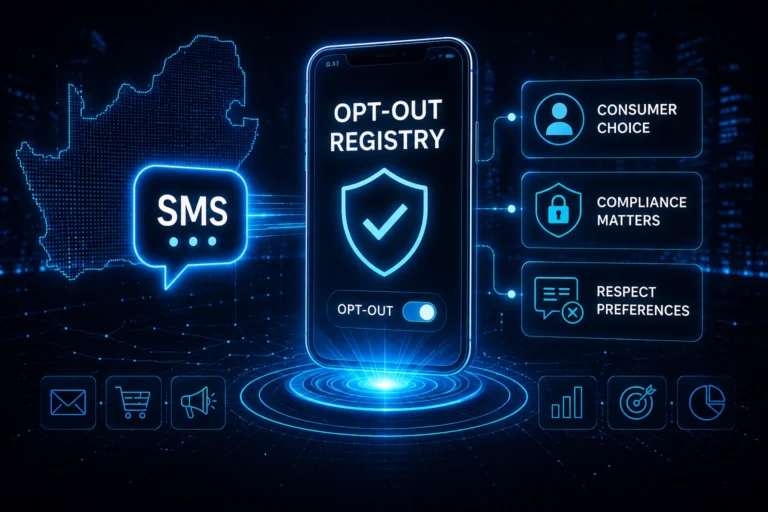
South African businesses conducting direct marketing now also need to consider the National Consumer Commission’s Direct Marketing Opt-Out Registry framework.
The Registry provides a central mechanism through which consumers can place blocks on unwanted direct marketing.
The NCC’s 2026/27 Annual Performance Plan includes the registration of direct marketers on the Opt-Out Registry as part of its consumer-protection programme.
These requirements are relevant to direct marketing, which is another reason businesses need to understand whether an SMS is operational or promotional in nature.
For a full explanation of the new requirements, read our guide to South Africa’s Direct Marketing Opt-Out Registry and SMS marketing compliance.
The Registry does not replace POPIA, and businesses should consider both frameworks when managing promotional SMS campaigns.
Transactional SMS Is Often More Time-Critical
Another important difference between transactional and promotional SMS is the expectation around timing.
Consider an OTP.
The customer may only have a few minutes to enter the code.
A message that arrives 30 minutes later is effectively useless.
The same applies to:
- Fraud alerts
- Account notifications
- Delivery updates
- Appointment changes
- Booking confirmations
- Urgent service notifications
Transactional SMS is therefore often judged primarily on reliable, timely delivery.
A promotional campaign has a different objective.
If a retailer sends a weekend sale message, marketers are more likely to assess:
- Delivery rate
- Click-through rate
- Conversion rate
- Revenue
- Bookings
- Store visits
- Customer responses
- Opt-outs
The SMS still needs to reach customers reliably, but the success of the campaign is ultimately determined by what recipients do after receiving it.
Transactional SMS Is a Natural Fit for Automation
Many transactional messages are triggered by a specific event.
For example:
Order placed → Send confirmation
Parcel dispatched → Send delivery update
Appointment approaching → Send reminder
Login verification requested → Send OTP
Payment received → Send confirmation
Because these events already occur inside business systems, transactional messaging is particularly well suited to automation.
An SMS API allows a business, website or software application to communicate with an SMS service so messages can be triggered automatically.
With the WinSMS REST API, developers can send SMS messages, retrieve delivery statuses, access incoming messages and work with other messaging functions programmatically.
For businesses wanting to explore this in more detail, our guide explains what an SMS API is and how it works.
This can be particularly useful for businesses that regularly send transactional messages such as confirmations, reminders, alerts and updates.
Promotional SMS Is Usually Built Around a Campaign
Promotional SMS is often managed differently.
Instead of being triggered by an individual customer action, the business may decide to send a campaign to a selected audience at a particular time.
For example:
Objective: Generate weekend sales
Audience: Existing customers interested in outdoor products
Offer: 20% off selected outdoor products
Send time: Thursday afternoon
CTA: Shop online
Measurement: Clicks and sales
This is where campaign planning, segmentation and scheduling become particularly important.
The WinSMS online Bulk SMS portal allows businesses to manage contacts, schedule messages and send Bulk SMS campaigns from an online interface.
For promotional messaging, that gives businesses a practical way to prepare a campaign in advance rather than manually messaging customers individually.
Can the Same Business Send Both Transactional and Promotional SMS?
Absolutely.
In fact, many businesses need both.
An online retailer might send:
Transactional:
- Order confirmation
- Payment confirmation
- Dispatch notification
- Delivery update
Promotional:
- Weekend sale
- New product launch
- Loyalty offer
- Black Friday campaign
A medical practice might send:
Transactional:
- Appointment reminder
- Booking confirmation
- Schedule change
Promotional:
- Marketing communications about eligible services, where appropriate
A school might send:
Transactional or operational:
- Schedule changes
- Event reminders
- Important notices
And a service business could use SMS for both appointment communication and relevant marketing campaigns.
WinSMS provides Bulk SMS products that can support different business messaging requirements, from online campaign sending to API integrations for automated messaging.
The important part is to structure those communications around their actual purpose.
How to Tell Whether an SMS Is Transactional or Promotional
If you are unsure how to classify a message, ask a few simple questions.
Question 1: Why Are We Sending This SMS?
Is the purpose to give the customer necessary information about something that has already happened or is happening?
That points towards transactional.
Is the purpose to encourage a purchase, booking, enquiry or other commercial action?
That points towards promotional.
Question 2: Did the Customer Trigger the Message?
If the SMS follows an action such as:
- Placing an order
- Requesting an OTP
- Making a booking
- Creating an account
- Making a payment
…it is more likely to be transactional.
But that alone is not enough.
The content of the message still matters.
Question 3: Does the Message Contain an Offer?
If the message contains:
- A discount
- A special offer
- A promotional link
- A new-product promotion
- An upsell
- A marketing call to action
…it has promotional content.
Question 4: Would We Still Need to Send This Message If We Had Nothing to Sell?
This is a useful practical test.
A delivery notification still needs to be sent even if the business is running no promotions.
An OTP still needs to be sent.
An appointment reminder still has a purpose.
A “20% off this weekend” message does not.
That distinction can make the purpose much clearer.
Quick Transactional vs Promotional SMS Test
Before sending, ask:
Is this SMS necessary to complete or support an existing transaction, service or customer action?
If yes, it is likely transactional.
Is the SMS designed to promote, advertise or encourage a new commercial action?
If yes, it is likely promotional.
Does it contain both?
If yes, consider separating the content into two messages rather than mixing operational and marketing communication.
Where the legal classification of a particular message is unclear, businesses should obtain appropriate professional advice rather than relying solely on internal labels.
Transactional and Promotional SMS Best-Practice Checklist
Before sending either type of SMS, check the following.
For Transactional SMS
- Is the message genuinely operational?
- Is the sender identifiable?
- Is the information accurate?
- Does it contain only the information the customer needs?
- Is it being triggered at the correct point in the customer journey?
- Does it need to be delivered immediately?
- Have you avoided adding unnecessary promotional content?
- Are automated triggers working correctly?
- Are delivery results being monitored?
For Promotional SMS
- Is there a clear marketing objective?
- Is the recipient appropriately included in the marketing audience?
- Have applicable consent or existing-customer requirements been considered?
- Have previous opt-outs been processed?
- Has the NCC Opt-Out Registry process been considered?
- Is the sender clearly identifiable?
- Can recipients request that future marketing stops?
- Is the offer relevant?
- Is there one clear call to action?
- Is the campaign being sent at an appropriate time?
- Will you measure campaign performance?
Frequently Asked Questions About Transactional and Promotional SMS
What is transactional SMS?
Transactional SMS is generally used to provide information relating to an existing transaction, service, account or customer action. Common examples include OTPs, order confirmations, appointment reminders, delivery updates, payment confirmations and account alerts.
What is promotional SMS?
Promotional SMS is messaging sent with a marketing or commercial purpose, such as promoting a sale, discount, product launch, event, service or special offer.
What is the main difference between transactional and promotional SMS?
The main difference is the purpose of the communication. Transactional SMS provides necessary or expected information, while promotional SMS is intended to market or promote a product, service, business or offer.
Is an appointment reminder transactional SMS?
An appointment reminder that simply provides information about an existing booking would generally be considered transactional or operational in nature. Adding a promotional offer to the same message can change the nature of the communication.
Is an OTP a transactional SMS?
Yes. An OTP is a typical example of transactional messaging because it is sent in response to an authentication or verification action and contains information required to complete that process.
Can a transactional SMS include a promotion?
Combining transactional and promotional content can turn an otherwise operational message into one that also has a marketing purpose. Businesses should generally keep the two types of communication separate so customer expectations and marketing preferences can be managed more clearly.
Does giving a business my mobile number mean it can send promotional SMS?
Not automatically. In South Africa, businesses need to consider POPIA Section 69 when using personal information for electronic direct marketing. There is also a limited existing-customer exception where specific requirements are met.
Do promotional SMS messages need an opt-out process?
Businesses conducting electronic direct marketing need to provide an appropriate way for recipients to request that future communications stop and must respect those preferences.
Can businesses automate transactional SMS?
Yes. Transactional messages are particularly suited to automation because they are often triggered by events such as an order, booking, payment or verification request. Businesses can integrate SMS into their systems using tools such as an SMS API.
Final Thoughts
Transactional SMS and promotional SMS may use the same basic communication channel, but they serve very different purposes.
Transactional SMS is about providing information.
Promotional SMS is about marketing.
One tells the customer:
“Here’s the update you need.”
The other says:
“Here’s something we’d like you to consider.”
Understanding that distinction can help businesses make better decisions about message content, automation, timing, audience selection and compliance.
It also helps protect the customer experience.
Someone who asks for an OTP should receive an OTP.
Someone waiting for a parcel should receive a useful delivery update.
And when a business wants to promote a sale, product or service, that campaign should be planned and managed as marketing.
For South African businesses, keeping these communication streams clear becomes even more important when considering POPIA, customer opt-outs and the NCC Direct Marketing Opt-Out Registry.
The practical approach is simple:
Start with the purpose of the message.
Keep transactional messages operational.
Treat promotional messages as marketing.
And avoid mixing the two simply because you already have the customer’s attention.
This article is intended for general informational purposes only and does not constitute legal advice. Businesses should consider the circumstances of their own communications and obtain professional advice where necessary.
Choose a Bulk SMS Provider You Can Trust
Not all Bulk SMS providers are created equal. WinSMS has helped South African businesses communicate reliably for over 20 years with transparent pricing, no expiry on credits, local support, powerful SMS APIs, and flexible messaging solutions designed to scale with your business.
Sign Up for a Free TrialNo contracts • No expiry • Local SA support
Supported Networks: Vodacom · MTN · Cell C · Telkom Mobile